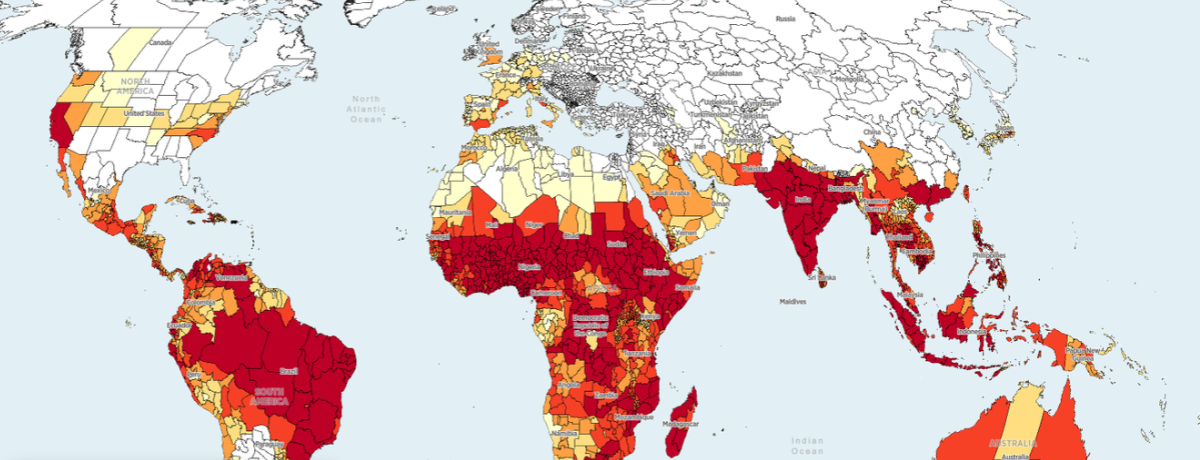
As this year’s “Super El Niño” shifts rainfall patterns and raises temperatures around the globe, the Climate Impact Lab has built a new tool—the El Niño Heat Mortality Tracker—to show where El Niño’s heat poses the greatest threat to human life. The Tracker provides monthly data showing projected deaths as far as six months out, as well as the number of heat-related deaths since El Niño began in June. By offering state/provincial-level data across the globe, it gives funders, policymakers, and practitioners the latest information on the most impacted regions, allowing them to prioritize where resources are most needed and where immediate action can save lives.
The tool builds off a report the Lab released last month projecting where the most lives could be lost from extreme hot days caused by El Niño through February. The Tracker now incorporates data through March, projecting that about 857,000 total deaths could result from El Niño’s extreme heat, with about 373,000 of those deaths projected to occur in the next six months.
“Our research puts new forecasting capabilities to work to answer one of the most urgent questions we face: where is extreme heat likely to cost lives?” says Michael Greenstone, a co-founder of the Climate Impact Lab and the Milton Friedman Distinguished Service Professor in Economics at the University of Chicago. “Being able to anticipate the deadly effects of extreme heat is a major step forward. It means we can identify where people face the greatest risks and give decision-makers a chance to act before lives are lost. The Tracker provides this information for the Super El Niño we’re living through today.”
El Niño’s heat deaths will be concentrated overwhelmingly in the Global South. Over the next six months (October-March), the latest data projects:
- Nigeria is forecasted to experience the highest toll from El Niño’s heat, with about 56,000 deaths projected spread across the six-month forecast period.
- India follows very closely, with about 55,000 heat-related deaths projected, most of them in March.
- Southeast Asia remains a major hotspot, with Indonesia projected to see about 29,000 lives lost due to El Niño’s heat.
- In Brazil, heat-related deaths are projected to be higher than average each month, totaling about 19,000 deaths over the forecast period.
Directing emergency response and resilience efforts to the high priority regions has the potential to save tens of thousands of lives. The Climate Impact Lab’s Adaptation Inventory provides a rigorous and regularly updated evidence base of adaptation measures that have been proven to save lives based on peer-reviewed research, from early warning systems that inform the expansion of healthcare access to cooling centers and protections for outdoor workers.
“Efforts are already underway to protect communities from this historic El Niño, but this new data highlights where action is most urgently needed,” says the Lab’s Faculty Head of Research Tamma Carleton, an Assistant Professor at the University of California, Berkeley. “The data also underscore the importance of addressing extreme heat and its deadly consequences in preparing for El Niño, alongside the extensive work already underway to combat threats to food security.”
The Lab will update the Tracker monthly through the end of the El Niño, providing an ongoing picture of how heat-related mortality risks evolve.
A Note on the Data: The projected total heat deaths from El Niño reported by the Tracker are significantly higher than projected in the Lab’s September report. Most of this increase was driven by two factors. First, the addition of March to the forecast—capturing more of the El Niño event. Second, the Tracker now accounts for observed, rather than forecasted, data for the months of August and September. The two months turned out to be much warmer than forecasted. In fact, August was the warmest August and September the second warmest September on record.