Recent research has uncovered that the greatest projected costs from climate change stem from the increased risk of mortality. However, understanding how a warming climate will impact mortality isn’t as simple as looking at what areas of the world will be the hottest. It also depends on the measures that individuals and governments can take to protect themselves. To date, the world has not paid enough attention to the potential benefits of adaptation investments or measures that can protect people from climate change’s projected damages, including its likely impacts on mortality.
This report identifies the regions around the world where climate adaptation offers the greatest opportunity to save the most lives, based on the Climate Impact Lab’s projections of temperature related mortality in 2050. The necessary adaptation investments will take many forms (e.g., changes in behavior, adoption of cooling technologies, etc.) and will need to be undertaken by people on the ground living these changes, the national and local governments that serve them, and philanthropic organizations that aim to support these people and governments.
Key Take Aways
How likely a person is to die from a warming climate depends on where they live.
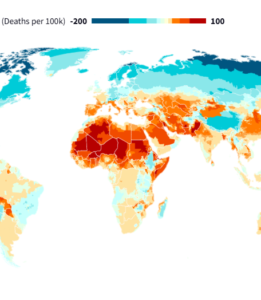
A warmer climate will lead to more deaths from extreme heat, and fewer deaths from extreme cold. As a result, cooler regions (mid-to-high latitudes) are projected to see a decrease in deaths, such as countries in Scandinavia where the temperature-related mortality rate is expected to decline by more than 70 deaths per 100,000 people. Meanwhile, hotter regions (lower-latitudes) such as Northern Africa, the Middle East, and Southwest Asia are projected to see more deaths. Those across the Sahel, such as Niger and Burkina Faso, are projected to see increases exceeding 60 deaths per 100,000 people—more than the mortality rate from malaria in Africa today (i.e., 52 deaths per 100,000). In Southwest Asia, Pakistan is projected to see a net increase in mortality of 51 deaths per 100,000 people by 2050, comparable to the loss of life due to stroke in that country today.
Today’s poorest populations are projected to suffer the most from a warming climate, making adaptation investments in low-income areas critical.
Investments in adaptation measures will be critical in low-income countries where the wealth necessary to reduce vulnerabilities is often lacking. Ten times more people are projected to die each year in lower-income countries (about 391,000 people) than in higher-income countries (about 39,000 people) due to shifting temperatures, despite being expected to have roughly equal populations. As an example, the country of Djibouti in East Africa is projected to experience an increase in temperature-related deaths that is two times that of the wealthier country of Kuwait in the Middle East, despite their similar climate. In Djibouti, temperature-related mortality is projected to increase by 55 deaths per 100,000, on par with the current death rate of HIV/AIDS, while Kuwait is projected to experience 25 additional deaths per 100,000, less than half the current death rate of heart disease. The same is true for the world’s densely-populated cities. While warm, wealthier cities like Phoenix and Madrid are projected to lose an additional 600 and 525 lives each year, respectively, due to a warming climate, Faisalabad, Pakistan, will lose an additional 9,400 lives. In fact, Pakistani cities will be the hardest hit as they see changes in temperature-related mortality exceeding that of today’s rates associated with tuberculosis, chronic obstructive pulmonary disease (COPD), and stroke. Within the cities that will experience an increase in temperature-related mortality, more than 100,000 lives will be lost across the globe, and 1 in 3 of those deaths will occur in Pakistani cities.
Highly-varied climates within countries underscore the need for targeted adaptation.
While some countries will experience significant increases in mortality across their entire territory, nations with diverse climates and topographies will see some areas benefit while others will experience negative impacts. For example, the continental United States is projected to see a wide range of impacts, with the northern states and Rocky Mountains experiencing a decrease in mortality rates by 30-60 deaths per 100,000 and the southern tier experiencing an increase of approximately 10 deaths per 100,000. This intra-country disparity is particularly important for those in lower-income countries deciding where to target their limited adaptation dollars, such as Bolivia. The mountainous regions of that South American nation, where it is generally cooler, fare significantly better than the more lowland parts of the country. Targeted interventions there would seek to address climate-related mortality in the southeast, which is projected to experience an additional 30 deaths per 100,000—on par with the current death rate of diabetes—rather than La Paz, which will see 17 fewer deaths per 100,000.
Without economic growth, there would be seven times more temperature-related deaths globally.
By 2050, projected income growth will reduce climate change’s global impact on mortality by about 9 deaths per 100,000 people, about equal to eliminating suicides across the globe. Accounting for this growth allows philanthropic organizations and decision makers of all levels to better target where adaptation measures are most needed by ensuring their efforts are additive. This report takes that projected income growth into account.
Climate Impact Lab research shows that temperature-related deaths are an inequitable threat to human wellbeing. This report identifies where additional resources and policies can most effectively reduce preventable deaths. Directing adaptation efforts toward the regions and cities highlighted would benefit communities across a wide range of possible climate futures.